


ORGTON Trail
Overview
ORGTON Trail is a game that introduces beginner backpackers to the essential knowledge they need to get started.
Starting backpacking as a hobby can feel intimidating without guidance or prior experience. ORGTON Trail aims to lower that barrier by placing you in the role of a hiking party leader on a simulated trip through a fictional national park, where you navigate changing weather, manage limited resources, and monitor your team’s physical and mental state, all while making decisions that determine whether everyone returns safely.
We worked closely with current and former staff from Outdoor Recreation Georgia Tech (ORGT) to understand their approach in guiding beginners and the common challenges faced by beginners. Throughout development, they also tested our prototype and provided invaluable feedback. The game was developed in Unity using C#.
Team Members
Leon Ma - Design, Development & UX Research
Christian Gutierrez - UX Research
Rosie Ye - UX Research
Academic Advisor
Dr. Ryan Scheiding
My Role
Literature review
Conducted interviews and surveys
Guided product direction
Translated design requirements into concrete design and core game mechanics
Developed the entire game in Unity (C#), including a solid simulation engine, while perfecting extensibility for new events and stats.
Improved prototypes according to new user feedback

However, challenges remain.
Beginners are held back by safety concerns, daunted by the inherent risks with outdoor activities and their lack of experience. Furthermore, though many outdoor enthusiasts pick up the hobby from family and friends, it is intimidating to start out for those who are not as connected to the outdoor community as they struggle to find mentors.
Thus, we want to
help beginner backpackers entering outdoor recreation build the essential skills, knowledge, and confidence they need to enjoy a trip.
What is ORGT?

Why did we work with ORGT?
We believe ORGT staff could tell us about the challenges involved while introducing beginners to outdoor recreation and the most effective ways to approach them.
Research
We started off everything with comprehensive research.

Open one of the following for details.

Game Reviews
The team members played and reviewed 8 games, drawing good design decisions that could inspire ours.

Firewatch
Developer:
Campo Santo
Year:
2016
A first-person narrative mystery where you play a fire lookout in the Wyoming wilderness, exploring the forest and unraveling strange events while building a relationship over radio with your supervisor
Why the Game is Relevant
-
Story can engage players, even if they are embedded simply.
-
Insider easter-eggs (in this case hikers/outdoor lovers) show that the designer understands the group's identity and appeal to specific audience
-
Making some parts intentionally hard (map reading) evokes valuable lessons about the real world.
-
Well exemplifies how real world outdoor themes can be embedded in the game
.jpeg)
Green Hell
Developer:
Creepy Jar
Year:
2019
A survival game set in the Amazon rainforest where you must manage hunger, injuries, shelter, and sanity while trying to stay alive and uncover what happened to you.
Why the Game is Relevant
-
Motor and micro level interaction: represent physical tasks in detail rather than skipping through, can nicely inspire our mini-game that teaches player "how to do things" on top of the strategy foundation.
-
Pack backpack: reflect the importance of packing/plan ahead from our interviews.
-
Manage health stats: inspire a stat-driven game. Force player to think of their physical limitation rather than do whatever they want, as their decisions effects stats in critical ways.

The Legend of Zelda:
Breath of the Wild
Developer:
Nintendo
Year:
2017
An open-world action-adventure game where Link explores a vast ruined kingdom, solves environmental puzzles, gathers gear, and prepares to defeat Calamity Ganon.
Why the Game is Relevant
-
Minimizes instruction and relies on exploration. Story itself should be satisfying.
-
Builds a complex environment and let multiple factors interact with each other.
-
Freedom to explore without constraint end goal. Maps to our idea that party can
make decisions on which path they choose, what places to explore on the map, though game goal does not require them to do so.

The Oregon Trail
Developer:
MECC
Year:
1971
A frontier survival simulation about leading a wagon party west across 19th-century America while managing supplies, illness, river crossings, and difficult travel choices.
Why the Game is Relevant
-
Making decisions that impact the whole group. Reflecting how outdoor leadership impacts outcome of the trip.
-
Route/map navigation: reflect the repeatedly emphasized importance of navigation from interviews and guidebooks.
-
Camping with social aspect: reflect that these trips are very social activities and we cannot underestimate the emotional/mental impact of social interaction.
-
Packing and supplies: Decide what to prepare, what to pick up along the way, distribution. Maps nicely to packing thinking (in real outdoor, gear and food is generally difficult to refill along the way, water could be picked up along the way to reduce weight)

Stardew Valley
Developer:
ConcernedApe
Year:
2016
A farming-life simulation where you inherit an old farm, grow crops, raise animals, build relationships, and gradually restore both the land and the surrounding town.
Why the Game is Relevant
-
A model of complex system of stats that interact with each other (time, energy,
money, seasons, and social relationships), which is what our simulation is about (time, members' mental and physical states, weather, inventory, facilities all interact with each other and determine the game outcome). This realistically reflects what real outdoor leaders are facing: risk management is a mindset about assessing how various dynamic factors influence risk, and making wise decisions accordingly, rather than a deterministic methodology.

Animal Crossing
Developer:
Nintendo
Year:
2001
A cozy social life sim centered on living in a village or island community, decorating your home, collecting items, befriending animal neighbors, and enjoying everyday routines at your own pace.
Why the Game is Relevant
-
Though not about outdoor, but teaches about planning, resource management and long-term strategy. Can inspire how we teach players to estimate relationship between time and resources and make plans accordingly (critical mindset to have outdoor).

Ring Fit Adventure
Developer:
Nintendo
Year:
2019
A fitness adventure game that turns exercise into combat and exploration, using real physical movements like jogging, squats, and presses to progress through an RPG-style quest.
Why the Game is Relevant
-
A physical movement driven game. May inspire us to develop mini motor skill games beyond typical PC interactions.
-
Demonstrates "embodied learning", or how players learn through repeated physical interaction and immediate feedback
-
highlights how knowledge and behavior change are most effective when
learning is inseparable from action, rather than delivered through explicit instruction.

Dave the Diver
Developer:
Mintrocket
Year:
2023
A hybrid adventure-management game where you dive for fish and treasures by day in a mysterious ocean trench, then help run a sushi restaurant by night.
Why the Game is Relevant
-
During dives, players manage oxygen, tools, and risk; later, they see the
consequences of those decisions through restaurant operations. This is similar to the decision-to-consequence bond trip leaders must familiarize themselves with outdoor. -
The game embeds domain knowledge—such as marine life and risk assessment—directly into gameplay. Humor and narrative make complex systems approachable and memorable.
-
This case shows how educational content can be layered into playful, hybrid systems without feeling instructional.

Literature Reviews
To understand the broader context of the outdoor recreation community our solution will be serving for, we have done extensive literature review covering a) the landscape of outdoor recreation in the US, b) theories in video game design for educational purpose, c) scholarly research on the effect of outdoor education, d) curriculum design by various outdoor recreation educational organizations, e) the topics included by authoritative outdoor recreation guidebooks, and f) guidelines for outdoor educators. The sources reviewed include scholarly books and articles, blogs, organization websites, and practical guidebooks.
a. Landscape of Outdoor Recreation in the US
USDA has asserted that “Outdoor recreation is an essential part of American culture”, a statement supported by enormous data and establishment of various American outdoor organizations. According to BEA, outdoor recreation generated $1.2 trillion in economic output and supported 5 million jobs in 2023, or 3.1 percent of all employees in the country. The American outdoor recreation culture is accompanied by notable public and private organizations from National Park Services (employs about 20,000 people in 433 units covering over 85 million acres) to Recreational Equipment, Inc (REI, a retailer with 181 stores and 15,000 employees). In 2021, 54% of Americans ages 6 and over participated in outdoor recreation at least once. Despite the apparent popularity of outdoor recreation in the US, it is well known that participation rate is divided among races, whereas people of color are far less likely to engage than others.
b. Theories in Video Game Design for Educational Purpose
Kurt Squire: Video Games and Learning (2011)
Kurt Squire’s 2011 book “Video Games and Learning” has been influential in theories related to video games as an educational medium. We will use it as a major guideline to design a video game for an educational application. The book defines a number of qualities that a game should possess to be considered a “good educational video game”, including but not limited to an overlapping and complex goal system, extended possibilities and surprises, opportunities for guided discovery, thought-provoking representation of reality, uncompromising aesthetics and artwork, support of continuous skill development and ground for an inviting and collaborative players’ community.
Scott Nicholson: A RECIPE for Meaningful Gamification (2015)
Nicholson's theoretical framework for meaningful gamification draws on Self-Determination Theory. Key results include the recognition that no single gamification system will benefit every user, that users need to be empowered to create within the system, and that systems need to provide the ability to learn and demonstrate mastery in different ways.
The chapter introduces six concepts: Reflection, Exposition, Choice, Information, Play, and Engagement, to guide designers of gamification systems that rely on non-reward-based game elements to help people find personal connections and meaning in a real-world context. Each element is worth unpacking precisely:
Reflection assists participants in finding other interests and past experiences that can deepen engagement and learning. Exposition creates stories for participants that are integrated with the real-world setting. Choice develops systems that put power in the hands of participants. Information uses game design and display concepts to allow participants to learn more about the real-world context. Play facilitates the freedom to explore and fail within boundaries. Engagement encourages participants to discover and learn from others interested in the same real-world setting.
The analytical force of RECIPE is that it shifts the design question from "how do we increase engagement metrics?" to "how do we build meaning?" It implicitly criticizes how "engagement" is typically measured: RECIPE suggests that "engagement" should be evaluated by reflection quality, agency, and sensemaking, not only retention or point accumulation.
Scott DeJong: Games as System Models for Media Literacy
DeJong's scholarship treats games as models of real-world systems: particularly information ecosystems driven by incentives, attention, and network effects. As a former elementary school teacher, DeJong became interested in how to teach people to fact-check and think critically, concluding that games offer tools for cooperation, engagement, and interaction that other formats cannot.

Kurt Squire

Scott DeJong

Scott Nicholson
c. Scholarly Research on the Effect of Outdoor Education
Though we searched for and reviewed scholarly articles on the topic of outdoor education to start work in grounded theories, we have found it difficult to find exact research on our topic, amateur’s acquisition of knowledge and skills in outdoor recreation. Most research focuses on education in outdoor settings and its impact on other factors such as personal growth and behaviors. Some research compares outdoor education to virtual education. Though this research frames outdoor recreation as a mean to an end, none is specifically about learning with outdoor recreation expertise as an outcome. Thus, we turn our eyes from scholarly sources to work by outdoor recreation practitioners to inform our design.
d. Curriculum Design by Various Outdoor Recreation Educational Organizations
Interviews with ORGT staff have already given us plenty of insights on what content the outdoor recreation instructors cover. These insights will be highly informative to how we define objectives of our games. Still, we also looked what content is included by other outdoor recreation educational organizations outside of Georgia Tech to get a comprehensive view of curricular content prioritized by the whole outdoor recreation industry. We started with the website of National Outdoor Leadership School (NOLS), which is probably the most authoritative organization on outdoor recreation education in the nation, a main host of Wilderness Risk Management Conference (MRMC) and a main developer of Leave No Trace (LNT) principles. We noted the learning objectives listed in the NOLS core curriculum and reviewed syllabuses of their courses. From NOLS, we expanded the sampling of learning objectives to workshops offered by Recreational Equipment, Inc (REI) and UCLA Recreation. We also looked at the educational philosophy and course plans from Outward Bound, an international outdoor education organization. We reviewed published content from the Association of Outdoor Recreation and Education (AORE), whose service is devoted more toward outdoor recreation professionals and educators rather than amateurs. Finally, we compared the content prioritized by all these organizations and put it into a table. Social responsibility & leadership and Decision making & risk management are emphasized in materials from all 5 organizations. Environmental ethics and Gear use & maintenance are found in learning objectives in all 4 organizations except AORE. Additionally, navigation and first-aid skills are found in the learning objectives of 3 organizations except AORE and Outward Bound.





e. Topics Included by Authoritative Outdoor Recreation Guidebooks
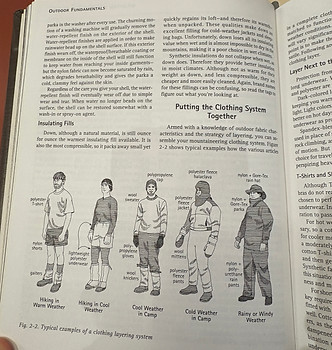
We refer to two authoritative and classic outdoor recreation guidebooks. Unlike scholarly literature which often focuses on a narrow, theoretical scope, these guidebooks are written to be extremely practical and referenceable for general outdoor recreationist audiences. They need to cover a broad range of useful topics while being concise and instructive. We think a popular and critically acclaimed guidebook would be extremely informative to our design, since the book may represent consensus from the general outdoor recreationist community on the most important and practical topics to teach to amateur recreationists. The first book, Mountaineering: The Freedom of the Hills, is written for the mountaineers but still well covers the foundational knowledge of general outdoor recreation. It has been frequently recommended in the outdoor recreationist community. The topics of the book echo a lot with what we learned from ORGT interviews. The book considers environmental ethics, physical and mental preparation, and judgement to be the foundational topics. The second part extensively explains clothing and equipment. The next section covers camping, water, and food. Then, the book devotes an entire section to navigation, which includes the use of maps and compasses. The second guidebook we referred to is NOLS’s Wilderness Guide, authored by the exact organization we investigated and continuously revised. Interestingly, the book opens with talks on leadership and team organization, reflecting the core mission of NOLS. The first part devotes to expedition planning, echoing with the repeated emphasis on criticalness of trip planning found in our interview notes. The second part is about equipment, covering footwear, sleeping system, pack, tent, and more. The third part is about layering. The fourth part is about camping, including LNT camping and bear camping. The fifth part, Travel Technique, also includes tips on resource management and care for one’s body. The rest of the book covers leadership, navigation, emergency procedures, weather, and cooking. Both guidebooks emphasize environmental ethics, careful planning, and navigation, which is consistent with findings from interviews and curriculum of organizations. They also both elaborate extensively on clothing and layering, with special notes on footwear.
.jpeg)



f. Guidelines for Outdoor Educators
Throughout our research, we have found it necessary to distinguish between “outdoor education” and “education for outdoor recreation”. The former is about education in outdoor settings as an educational method, and the content does not have to be about outdoor recreation. The latter is about education that prepares learners for outdoor recreation activities, and it does not have to happen in outdoor settings. Scholarly researchers are overwhelmingly interested in the former, while we are studying the latter, which is why we find scholarly research hardly helpful. Still, we find one book about outdoor education but still gives plenty of examples qualifying for education for outdoor recreation: “Outdoor education: Methods and strategies”. This source adds a fresh perspective to our literature review as it is a guide written for any educator who uses outdoors as a main medium for education, no matter if they are a schoolteacher or an outdoor activity instructor. It is a practical guide like the previous two we have reviewed, but only for educators rather than learners. Though playing a video game is not outdoor education, we think it may be possible to summon some good qualities found in outdoor education. This guide covers relevant theories in education including constructivism (education that considers students’ existing knowledge or beliefs), and developmental stages of environmental learning (which implies a need to clear students’ misconceptions that influence their survival instincts). By applying these theories, we may make a game that clears some common survival related misconceptions. For example, risks from wildlife may be overestimated compared to other risks. Players may soon find the weather to be more worrisome. Furthermore, the guide covers the method of using simulation for training, as well as building scenarios (a method also recommended by ORGT staff).

Surveys
We polled anyone who has an interest in outdoor recreation regardless of experience level, and received 28 responses. Most of them are novices: 14 acknowledge that they are "not confident at all" about their outdoor knowledge. This signifies that we polled a fair sample of our target audience, the interested outdoor recreation beginners.

We found that friends and family are the most important learning source of outdoor recreation knowledge. 21/28 say they learn most of their outdoor knowledge from friends or family. Many experienced outdoor recreation hobbyists got to where they are today under the heavy influence of friends and family. Meanwhile, people who did not grow up in such environment are left at a significant disadvantage when it comes to gaining relevant knowledge and experience.

We found that most prioritize safety-related topics as their learning goal. 22/28 pick "survival and first aid" and 18/28 pick "safety" as 1 of 3 topics they are most interested in learning more about. This gives us a clear "safety-first" educational goal for our game design.

When asked about the biggest barrier that prevents people (especially students) from engaging in outdoor recreation, people frequently cite cost of gear, time commitment, effort to organize group activity, safety, and the need to leave comfort zone as top reasons.

Some people went on the recent MS-HCI camping trip, and they are asked about what surprised them, what they learned from the trip, and what they wish they had known before the trip. The responses consistently suggest there exists a gap between expectation and reality. The need to be sufficiently informed of what to expect ahead of time becomes a huge design opportunity.


Interviews
We interviewed 8 ORGT staff members & 2 Outdoor enthusiasts, with more than 10 hours of interview time.
Our team took more time coding the notes and extracting common themes.

As a result, we are able to synthesize quantified data, such as what the trip leaders see as important learning areas to communicate to the participants:

But most importantly, we are able to condense the information from the interviews. For example, we can convert 30 raw interview sticky notes like this:

into 3 notes:

and eventually into 1 note:

We have cut hundreds of raw sticky notes into around 20 pink notes. Eventually, we summarize them into 5 critical insights, which will inform our eventual game design goals.
5 Interview Insights
1. Communication and setting expectations before trips are essential.
2. Outdoor adventures are inherently social activities.
3. Successful outdoor trips are about investigating before hand, predicting and planning.
4. Safety is the top priority.
5. Although in-person training is the most effective, its space and time constraints create opportunities for digital tools.
Design Requirement
This map summarizes all research above and how they synthesize into a set of design requirements. On the left we have sources of research. We synthesized research into common themes which is useful for deciding what to simulate in our game. Finally, we translate research into two categories of design requirements: theorists’ criteria which define what makes an effective educational game, and educational goals, which define what we’d like to teach players through this game.
(Click on the map to magnify)
.png)
Theorists' Criteria
These design requirements are inspired by the work of video game design theorists in our literature review. They capture the scholars' opinions on what an effective educational game should achieve.
Overlapping and complex goal system.

Extended possibilities that keep giving players surprises

Allows players to discover the underlying model

Uncompromising aesthetics and artwork

Reflection: Learning is a process that extends beyond the activity itself and must connect to a user's living context

Choice: Users should feel they have agency and multiple viable paths, rather than one optimal behavior to grind

Information: Feedback is meant to explain why outcomes happen and how users can improve

Play: Experimentation and failure are necessary conditions for learning

Game as Model of Real World System

Educational Goals
These design requirements are heavily inspired by curriculum design of various outdoor recreation organizations, outdoor recreation guidebooks, responses to our surveys as well as interview insights. They define what the game should teach players.
Set realistic expectation on the mental and physical challenges ahead

Prompt participants to jump out of an individual perspective and see the trip from a leader or team perspective.

Demonstrate how deliberate planning and optimal team dynamics are critical to a trip’s success.

Show how a good outdoor recreationist should not only have technical expertise but also emotional intelligence, as outdoor adventures are inherently social activities.

Teach the core philosophy of risk management or responding to dynamic and ever-changing situations to ensure safety.

Prompt players to be responsible backpackers by practicing Leave No Trace and bear-proofing.
.png)
Ideation

The main interface shows the map that the party navigates through. It also shows important simulated components like time, weather, mental & physical states of the party, and states of resources like food and water.
We should give players the experience of planning a trip, including selecting party members and gear to pack.


We show that backpacking is not just a sport and an inherently social activity, meaning we should introduce social interactions.
The game will be driven by a series of events where players have to make critical decisions that drive the eventual outcome of the game.


And beyond simple decision making, the game can also teach players specific actions like pitching a tent or filtering water through mini games.
The game should simulate the complex interplay between event, player response and game states. While a single decision does not cause definite success or failure, we want to show players the consequence of their choices and motivate them to make wise decisions.

Core Design Philosophy
Simulate, not tell. Players learn for themselves.
Prototype Iteration & Feedback
We built 5 prototypes in total, each improving upon the previous version with feedback from ORGT staff members after they play through the game.

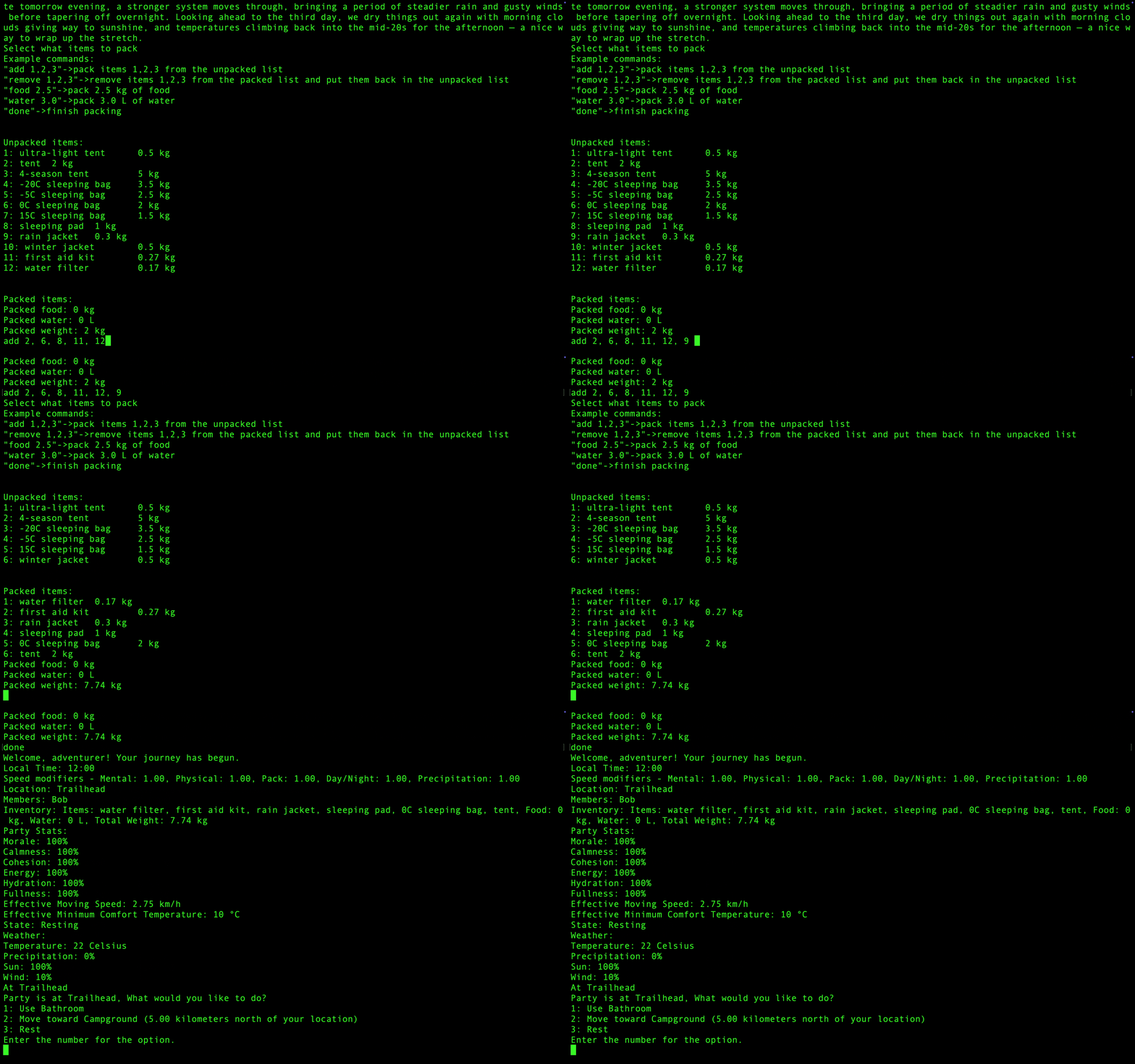
Command Line Prototype
-
A .NET Console app developed in C#
-
Interaction through a command line interface (CLI)
-
Can simulate the essential underlying mechanics: All in-game stats, movement on the map, event system, handling of player responses, weather, etc.
Game Build 1.03

-
Made in Unity. Used the simulation code from the CLI prototype.
-
The first build of prototype with a graphical user interface that is tested.
-
Includes UIs supporting planning stages like selecting season, goal, party members and packed items.
-
Displays all in-game stat bars, clock, weather, etc.
-
Shows avatar location on map and movement animation.
-
Displays game summary.

Feedback for Game Build 1.03
What works
-
“The game force you to think about what to take and not take or you may regret later”
-
“The game is very inviting. It makes you want to do things yourself.”
-
The game teaches well about being cognizant of your surroundings and knowing what to bring.
Suggested Improvement
-
Not sure when sunrise/sunset happens
-
Representing rain, wind and sun as a percentage is unintuitive
-
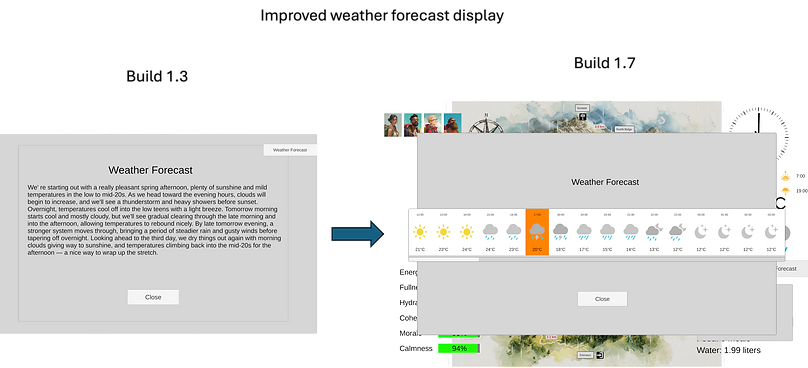
Would like to see weather forecast in a timeline visual format and accessible through gameplay
-
Continuous and over-night food consumption is unrealistic. Should force player to stop and eat.
-
Would like to see how different response options to an event affect stats, or more transparent choice-to-consequence relationship

Improved Weather Display

Game Build 1.07

-
Background music volume becomes adjustable.
-
Changed display of weather from stat bars to a more conventional timeline view, which displays weather icons and temperatures each hour.
-
Replaced the text-based weather forecast to a visual timeline. Weather forecast is always available during game play.
-
Changed food consumption mechanics from continuous implicit consumption to one-time explicit consumption that must be initiated by player. This simulates the need of hikers having to stop for meal. Food is now counted by number of meals rather than by weight.
Feedback for Game Build 1.07
What works
-
This game shows that “every action has a consequence, which shows very much so in the outdoors”
-
It forces beginners “to think about front country/back country”
-
“I really like the interface.”
-
“I like that it shows golden hour”
-
“The animation runs smoothly.”
-
“It gives me confidence boost as a trip leader, not having to drag people in and out”
-
“It teaches well about food, water and weather”
-
Earlier choice seems meaningful “when I see water goes down”
-
“This is 8 or 9 out of 10 on enjoyableness.”
-
“This is most beneficial during the classroom session. Just watch everyone plays through it. And see if any mistake is there. “
Suggested Improvement
-
All units are metric, making it difficult to estimate for people unused to metric system. We should introduce US units.
-
Should add a button to skip animation (relevant when you are camping and want to skip to next morning)
-
Should be able to preview features at a certain location on map (Relevant when you are planning and want to know where you can refill water)
-
Would like to see the effect of each inventory item at the time of packing
-
The game should teach Leave No Trace principles.
-
Would like to see where each next possible destination is on map without having to toggle event box on and off to check the map.
Added Dual Unit System

Added Description of Map Features

Added Tooltip Description

Game Build 1.09

-
Player can choose between metric system and US customary units. The unit setting updates all distance, weight and temperature units.
-
Added a description of location features on the map at goal selection stage, and let player preview the map while packing.
-
Added tooltip description of function of each available inventory item.
-
Button highlight for selected season and goal.
-
Added label for moving speed and pack weight.
Feedback for Game Build 1.09
What works
-
“The UI is clear. The boxes are good.”
-
“The weather feature is nice”
-
“The music is dramatic.”
-
“Food, water and injury all make sense”
-
The game helps understand consequences of your choices. “Yes, after I mess it up first time.”
-
The game teaches you to think ahead, like "I need to have this thing (first aid) with me”
-
“Gear selection, water and food are meaningful choices”
-
“Planning aspect is interesting. It's a nice low pressure way to experience planning. “
-
“It was all very clear. All the prompts are well written.”
-
Consequence of choice: “Very clear.” (Things like bringing a rain jacket)
-
“Definitely led people thinking about what to prepare.”
-
Meaningful choices? “Yes. They are all natural consequences.”
-
Boredom/frustration? “Don't think so. I was enjoying myself."
Suggested Improvement
-
Would like to see more context or what to expect before the actual gameplay starts.
-
Would like to see a better visual aesthetics on UI for a very fun game
-
Would like to see more diversity in events other than homesickness. Teach players about bearproofing, leave no trace, etc.
Stylized UI Across All Screens

Added Stop/Skip Buttons

Added Mini Slideshow Module


Game Build 1.10

-
Added an introductory paragraph at the beginning of the game explaining the context.
-
Added buttons to stop or skip animations. This allows player to stop camping earlier than planned, stop on the way to a destination, skip till next morning, etc.
-
Added a mini slideshow module that teaches player certain actions like pitching a tent, filtering water and using a bear cable.
-
Stylized UI across the game, enhancing esthetics.
Evaluation
We evaluated the effectiveness of the game against our core learning goals. To collect data, we relied on observation during the gameplay, comments during and after the gameplay, and post-game surveys. The player profiles are a mixture of outdoor recreation experts and amateurs.
The following statements summarize our key findings.
The game is strong at teaching consequences of one’s choices.
From live testing sessions, 5/6 of the testers recognize that the game successfully teaches importance of planning and lets players understand consequences of their choices.
“This game shows that “every action has a consequence, which shows very much so in the outdoors”
From surveys, everyone agreed choices in the game feel meaningful.
“The choices felt meaningful because you try to balance what you do at each stop according to how your hike it going. I do feel like the phrasing of some of the action can be interpreted in other ways that make your expected outcome not align with what the game actually does (like resting not meaning sleep).”
“I felt that my choices in the game led to positive or negative results, and that the game wouldn't "win itself" if I made arbitrary choices.”
Why It Matters
Scott Nicholson (Theorists’ Criteria)
“Play”: Experimentation and failure are necessary conditions for learning
Scott Nicholson (Theorists’ Criteria)
“Choice”: users should feel they have agency and multiple viable paths, rather than one optimal behavior to grind
Educational Goal
Demonstrate how deliberate planning and optimal team dynamics are critical to a trip’s success.
Educational Goal
Teach the core philosophy of risk management or responding to dynamic and ever-changing situations to ensure safety.
The game is strong at teaching planning & packing
Comments from Testing Sessions
“It teaches well about food, water and weather”
“The game teaches you to think ahead, like ‘I need to have this thing (first aid) with me’”
“The game force you to think about what to take and not take or you may regret later”
“The game teaches well about being cognizant of your surroundings and knowing what to bring.”
“Planning aspect is interesting. It's a nice low-pressure way to experience planning.”
“Definitely led people thinking about what to prepare.”
From surveys, everyone agrees they learn about Planning
From surveys, everyone agrees the game represents camping ”gear” well.
Why It Matters
Educational Goal
Demonstrate how deliberate planning and optimal team dynamics are critical to a trip’s success.
The game has a strong appeal.
Comments from Testing Sessions
“The game is very inviting. It makes you want to do things yourself.”
“This is 8 or 9 out of 10 on enjoyableness.”
“I like the concept a lot. I can see myself getting more interested in doing outdoors activities by being introduced to them in a controlled and simulated environment."
The game represents the weather well.
Comments from Testing Sessions
“I like that it shows golden hour”
“The weather feature is nice”
From surveys, everyone says they learn about weather from the game
Outdoor recreation experts and novices have mixed opinions on system feedback and UI clarity.
6/6 of ORGT staff testers say the game has clear UI and system feedback
According to surveys, most disagree that they encounter “moments during gameplay that felt confusing or difficult to understand”
However, the UI can be confusing to complete beginners:
“There is a lot of things that are not explained, specially for someone who has never done these types of things before. ”
“UI is confusing. I would like to see my stats and screen as I am working through this. Additionally, I would like the dialogue to give me advice or specific things to help me do better choices in the next turn.”
“I felt that the consequences later down the road were implicit feedback for choices earlier in the game. I didn’t think that the direct impacts were always clear.”
Why It Matters
Scott Nicholson (Theorists’ Criteria)
“Information”: feedback is meant to explain why outcomes happen and how users can improve
Players appreciate the large number of options available.
Comments from testing sessions
“The large variety of options given to the player at each turn. I felt like the player had a lot of autonomy rather than being "led" down one route of gameplay.”
“I like how you can just go anywhere on the map in any order I prefer”
From surveys, everyone agreed choices in the game feel meaningful.
“The choices felt meaningful because you try to balance what you do at each stop according to how your hike it going. I do feel like the phrasing of some of the action can be interpreted in other ways that make your expected outcome not align with what the game actually does (like resting not meaning sleep).”
“I felt that my choices in the game led to positive or negative results, and that the game wouldn't "win itself" if I made arbitrary choices.”
Why It Matters
Kurt Squire (Theorists’ Criteria)
Extended possibilities that keep giving player surprises
Scott Nicholson (Theorists’ Criteria)
“Choice”: users should feel they have agency and multiple viable paths, rather than one optimal behavior to grind
Evaluation Summary
The players feel the impact of their choices, and they build confidence as they spend more time playing the game. Experts agree that the game is valuable to beginners and has achieved its educational goals. As a result of playing the game, players understand the importance of planning and how their choices have consequences.
For future improvement, we should work on system clarity. We can introduce a tutorial before the gameplay starts, and provide more feedback when players are making mistakes. We should strengthen mini slideshow modules for more effective training. Lastly, we can redesign UI to avoid clutter and add more feedback to buttons.